Synlogica Book a call

Probabilistic decisioning for regulated pharma

A 2-day excursion review. Sealed in under 60 seconds.

Synlogica Terminus reads your evidence — logger files, freight tenders, supplier offers — and turns it into a clear, governed recommendation. Every step is recorded for the auditor. Your people make the final call.

~2 d <60 s
decision lead-time
100%
evidence traced
Cat 4
GAMP 5 · qualified once

BUILT IN EU · GDPR · GAMP 5 CAT 4 · 21 CFR PART 11 · EU GMP ANNEX 11 · EU GDP

Follow batch PL-2026-0417-C through the chain of custody ↓

Decision package

Built by operators, ready for the regulator

Synlogica Terminus is built by a team with 19 years in pharmaceutical quality, logistics and procurement — so every decision package answers what your inspection committee will actually ask.

19 yrs
in pharma operations
3 domains
Quality · Transport · Negotiation
GAMP 5 Cat 4
validated lifecycle, qualified once

Three decisions, one engine

Where regulated teams lose time and money

Three decision domains, each a Terminus module sharing one governed decision framework — so rules, versioning and the audit trail behave identically whether the question is a temperature excursion, a freight tender or a supplier price.

Terminus M4

Quality

Temperature excursions assessed with Arrhenius + Monte-Carlo against the product's stability model — a recommendation with stated uncertainty, not a reviewer's guess.

See Quality →
Terminus M1

Transport

Tender leakage measured across SKU × lane × month, lanes scored by tail-risk — so spot-freight inflation is caught before invoices reconcile.

Read the tender-leakage paper →
Terminus M5

Negotiation

MESO playbooks for API procurement — simultaneous-equivalent offers framed against a qualified BATNA when supplier qualification is the binding constraint.

Read the MESO playbook →
Validation & governance

Terminus M4 is being validated under Synlogica's Integrated Management System (IMS) — ISO 9001 (quality), ISO 27001 (information security) and ISO 42001 (AI management) — on top of its GAMP 5 Category 4 lifecycle.

IMS certification target Q4 2026

GRIP · the engine under the hood

Hard rules, probabilistic models, one decision policy

Every recommendation carries the exact rule and model versions that produced it — reproducible bit-for-bit, and packaged so a reviewer or inspector can reconstruct what was decided, on what evidence, under which ruleset.

01 · Hard rules

Deterministic, versioned thresholds and policies — approved limits, storage classes, quality-agreement clauses. Tenant-configurable, never silently changed.

02 · Probabilistic models

Arrhenius kinetics, Bayesian elasticity, Monte-Carlo coverage — each with a stated confidence interval and the data-quality flags behind it.

03 · Decision policy

Maps the analysis to an advisory recommendation — and hands it, with its evidence, to the authorized human who makes the binding call.

New to these terms? Read them in plain language
Arrhenius
A formula from chemistry: the warmer a product gets, the faster it spoils. Terminus uses it to work out how much shelf life an excursion really cost.
Monte-Carlo
Instead of one guess, the computer plays out thousands of possible scenarios and reports how often the result stays safe.
MKT
One single “average” temperature that fairly sums up a whole journey of ups and downs.
MESO
Putting several equally good offers on the table at once — the supplier's choice reveals what they really care about.
BATNA
Your best plan B if the deal falls through. Knowing it tells you when to say no.
ALCOA+
The regulator's checklist for records you can trust: who wrote it, when, is it the original, is it correct.

Inside Terminus · illustrative UI

The decision, the evidence and the confidence — in one governed workspace

An illustrative preview on synthetic data — showing how a sealed decision package and the Decision Hub actually look. Not a customer screenshot.

Illustrative Synlogica Terminus decision-package screen — cold-chain excursion assessed with Arrhenius and Monte-Carlo, CONDITIONAL verdict at 87% model confidence, audit trail and e-signature gate
Decision package — evidence, confidence distribution & sealed audit trail
Illustrative Synlogica Terminus Decision Hub screen — list of quality, transport and negotiation decisions with RELEASE, CONDITIONAL and HOLD verdicts and confidence scores
Decision Hub — Quality, Transport & Negotiation decisions in one view

Illustrative interface on synthetic data — representative of Synlogica Terminus, not a specific customer deployment.

M4 · Quality Analysis

From logger file to sealed decision — four governed steps

Step 1 · Evidence in

Load the evidence

Drop the logger export and the stability documents. Terminus parses and screens every input — gaps, outliers, out-of-range readings — before a single number is computed (ALCOA+).

  • Any logger layout — unknown formats confirmed before use
  • Every file pinned into the audit trail, input-by-input
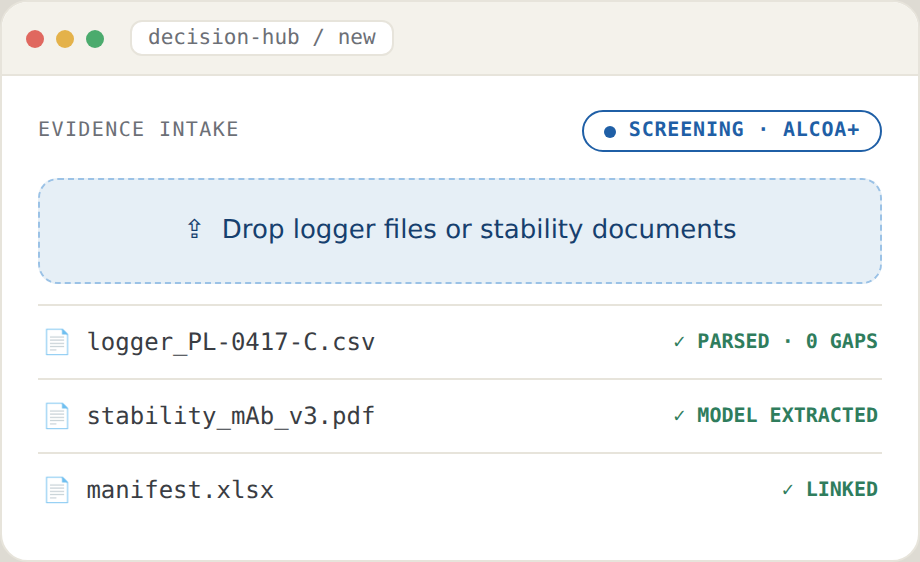
Illustrative Terminus evidence-intake screen — logger CSV, stability PDF and manifest parsed and screened with ALCOA+ checks passing

Step 2 · Kinetics

Model the exposure

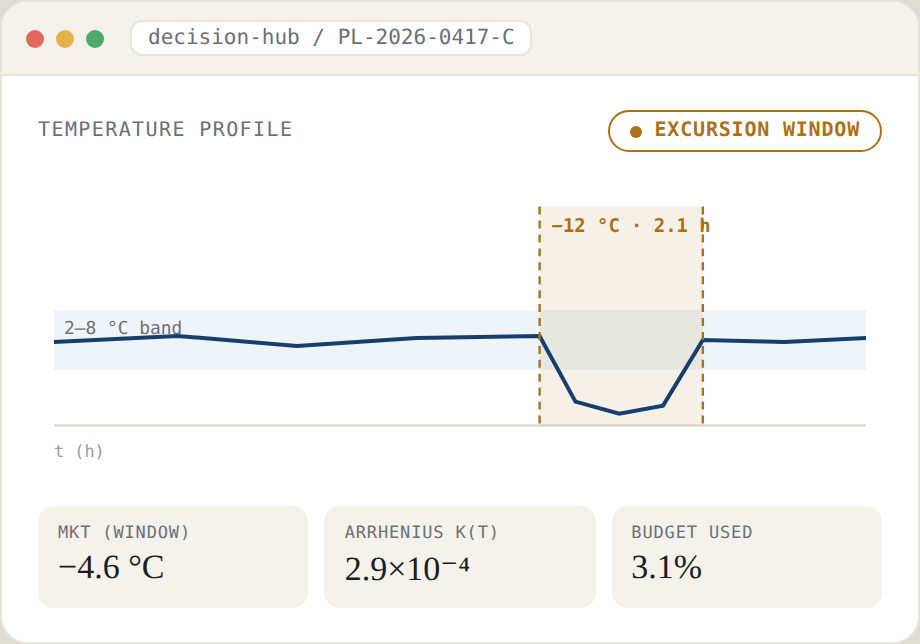
The temperature profile becomes MKT and Arrhenius k(T) — how much of the product's stability budget the excursion actually consumed, not just “how long it was warm”.

  • Product-specific stability model, version-pinned
  • Cumulative exposure, not peak temperature
Illustrative Terminus kinetics screen — temperature profile with a freezer-excursion window below the 2–8 °C band, plus MKT, Arrhenius k(T) and stability-budget tiles

Step 3 · Probability

Simulate the uncertainty

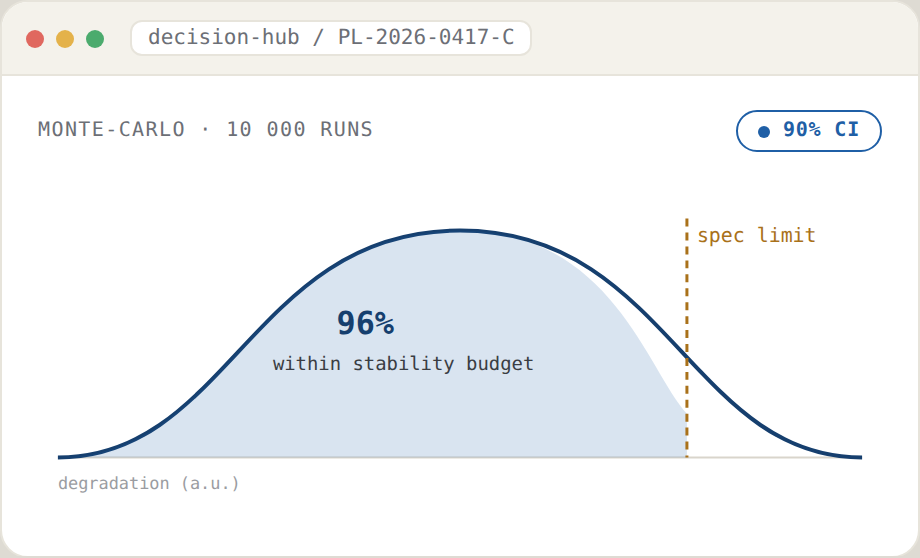
10,000 Monte-Carlo runs turn the kinetics into a probability with a stated confidence interval — “96% within the stability budget”, not a point estimate or a reviewer's gut feel.

  • Confidence interval stated on every result
  • Data-quality flags carried into the verdict
Illustrative Terminus Monte-Carlo screen — degradation distribution over 10,000 runs, 96% within the stability budget against the spec limit

Step 4 · Decision

Decide with authority

Terminus states an advisory verdict with the full sealed trail — inputs, model versions, ruleset. The authorized human (QA / QP) makes the binding release call, recorded in your QMS.

  • Reproducible bit-for-bit for the auditor
  • e-signature gate — the human stays the decision authority
Decision package · PL-2026-0417-C● Sealed
Model hash
a7f3…9c1e
Inputs pinned
14 / 14
RULESET
v2.4.1 · MC-90
Terminus M4prepared by · engine
You (QA / QP)approved by · e-signature
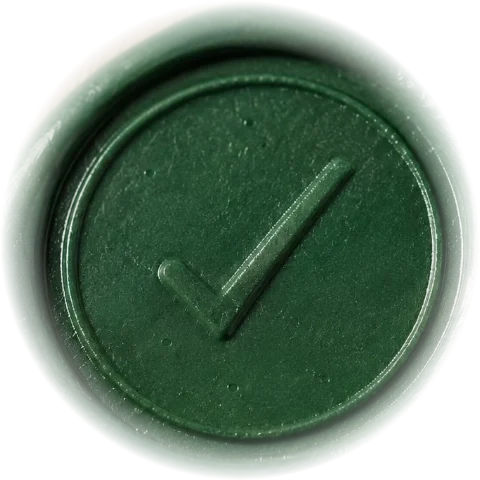
Green wax seal with an embossed checkmark — the decision package is sealedRELEASE · 2026-06-18

Illustrative interface on synthetic data — the same worked batch (PL-2026-0417-C) at every step.

The same chain of custody runs for freight (Terminus M1) and supplier negotiation (Terminus M5) — three modules, one governed platform.

<60 sec
to a defensible decision package
100%
evidence traced, input-by-input
RELEASE
· CONDITIONAL · HOLD, rule-derived

Illustrative figures for this workflow. For the sourced, measured comparison and method, see “Measured, not estimated” below.

Read how the engine works →

Measured, not estimated

Every figure here is measured against real workflows — and published

The numbers below come from comparing governed decisioning with typical manual QA excursion workflows. The full method and anonymized pilot data are in the white paper — so you can audit the claim, not just take our word for it.

Typical manual review ~2 days
Governed decision package under 60 sec

100% of evidence traced, input-by-input

Read the method + anonymized pilot data →

Compare

Manual review vs governed decisioning

Typical manual workflow Terminus
Excursion assessment Spreadsheets, reviewer-dependent Versioned model + stated uncertainty
Decision lead-time ~2 days under 60 seconds
Audit defensibility Reconstructed by hand Decision package, reproducible
Method consistency Varies by reviewer Same engine, tenant-configured rules
Validation posture Ad-hoc GAMP 5 Cat 4 — qualified once

Compliance & trust

Built for the regulator, not just the demo

Every decision is built to answer the questions an inspector will really ask. Hosted in the EU. Backed by evidence. Mapped to the standards you already work with.

  • Built in EU
  • EU data residency
  • GDPR
  • GAMP 5 Cat 4
  • 21 CFR Part 11
  • EU GMP Annex 11
  • EU GDP
  • Cookieless analytics
Integrated Management System (IMS) — certification roadmap
  • ISO 9001 · Quality
  • ISO 27001 · Information security
  • ISO 42001 · AI management
Certification target Q4 2026
See the full trust pack →

Talk to us

Start with your own decision package

Working session

Validate against your SOPs, on your data

We start with a working review of a sample decision package and its validation assumptions against your intended use — to agree the configuration baseline and the shared-responsibility split before anything goes live.

GAMP 5 Cat 4 documentation set & supplier evidence
Configurable thresholds, mailing groups & hosting
EU data residency or alternative cloud / on-prem

Bring a real workflow — a recent excursion, an upcoming tender, or a supplier price claim — and we walk it through Terminus together.

Opens your email app — nothing is sent to a third party or stored on a server.

FAQ

The questions QA & validation always ask

Is Terminus a batch-release system?

No — it is advisory by design. Synlogica Terminus produces a decision-support recommendation (RELEASE / CONDITIONAL / HOLD) with full traceability; the formal batch disposition is made and signed by the Authorized Quality Reviewer (QA / QP), recorded in your QMS.

How is it validated?

Terminus is positioned as configurable software (GAMP 5 Category 4), validated through a risk-based lifecycle — intended use, configuration, requirements traceability, IQ/OQ/PQ, data-integrity and audit-trail verification. Synlogica provides product and supplier evidence; the regulated user owns the validated state for their intended use.

What about data integrity and 21 CFR Part 11?

Records are versioned; controlled edits require a reason and an e-signature gate (password re-authentication); the audit trail is immutable, attributable and exportable as CSV. Sensor data is screened for outliers, out-of-range readings and gaps before use (ALCOA+).

Which decisions does it cover?

Three domains on one engine: Quality (temperature excursions and shelf-life impact), Transport (tender leakage and freight risk), and Negotiation (MESO framing for API procurement).

Where does it run?

Cloud-native — Kubernetes on AWS EC2 with AWS S3 for durable, WORM-capable storage, under the AWS shared-responsibility model. EU data residency or an alternative cloud / on-prem topology is configurable per your hosting policy.

Does it use AI / LLMs to make the decision?

No. LLMs assist only with extraction and structuring of unstructured inputs (e.g. parsing a stability PDF or an unknown logger layout), always confirmed before use. The recommendation itself comes from deterministic, version-pinned rules and the kinetic / probabilistic models.

Load the evidence. Let the engine conclude. Keep the human in charge.

A full trail from logger file to client report — for quality, transport and negotiation.

Book a call →